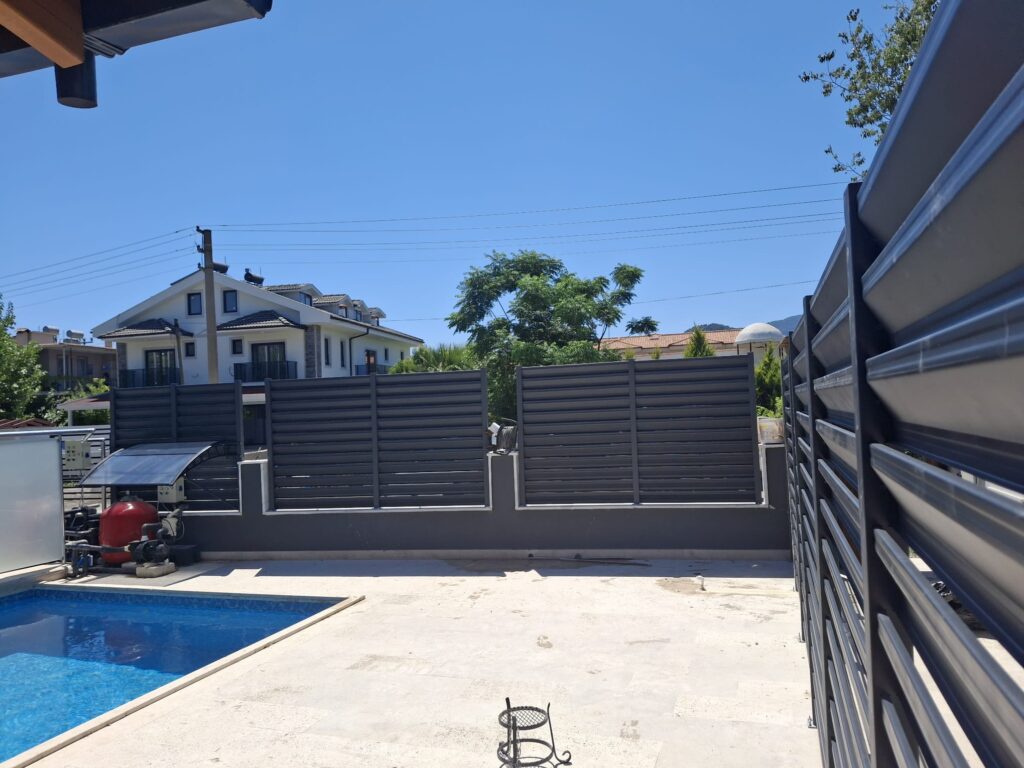
How Durable Are Metal Slat Fence Panels?
In recent years, metal slat fence panels have become increasingly popular due to their modern appearance and cost-effective pricing. However, many people assume that because of the relatively thin steel slats, these fences may not withstand strong winds.
On the market, slat thickness typically ranges from 0.6 mm to 1.2 mm. One of the most frequently asked questions by buyers is:
“What is the slat thickness?”
The common assumption is:
Thicker slats = Stronger fence.
However, this perspective is incomplete.
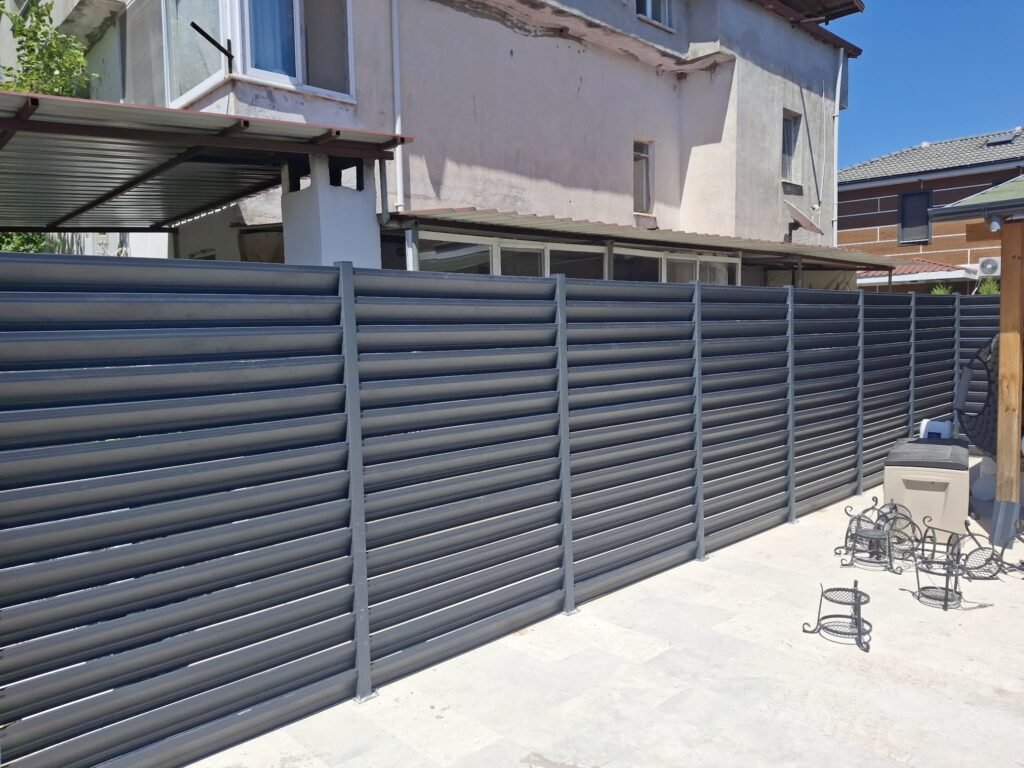
While louver thickness contributes to durability, it is not the only determining factor. The structural strength of a fence system depends on multiple engineering parameters, including:
- Slat thickness
- Slat profile design
- Number and geometry of bends
- Developed sheet width (flat sheet width before forming)
- Material grade and hardness
- Post thickness and cross-sectional design
- Slat-to-post connection system
For example, a fence manufactured from 0.7 mm galvanized steel can be significantly stronger than a fence made from 1.0 mm steel, depending on the profile design and material properties.
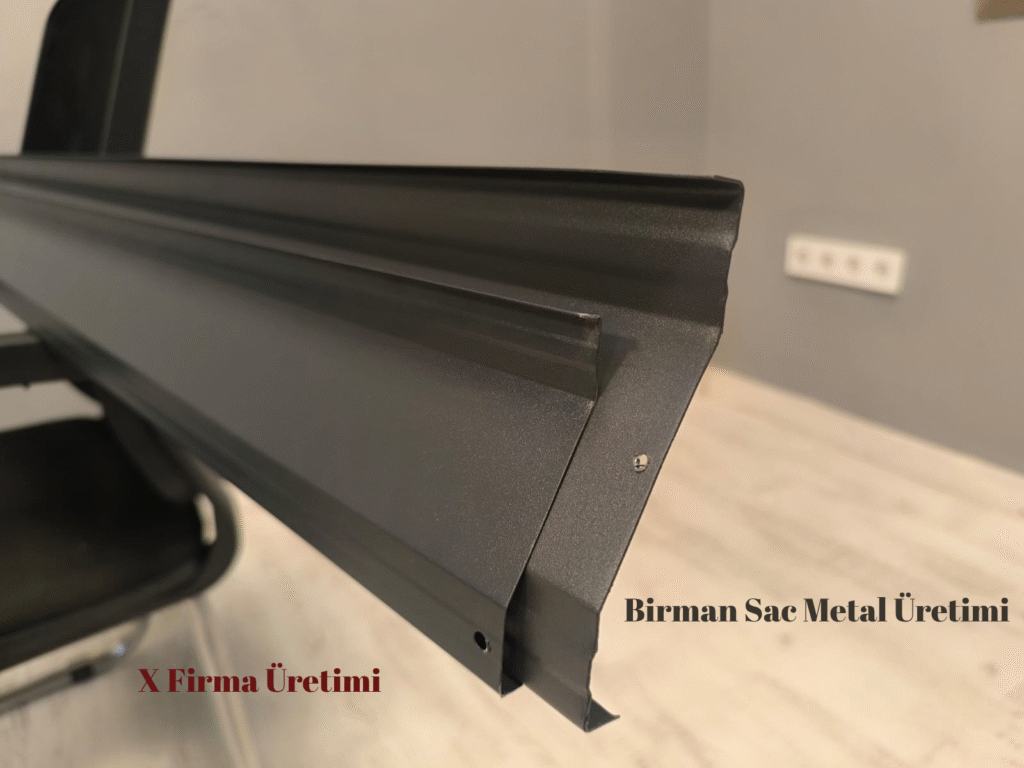
A 0.7 mm slat produced from high-strength steel with a developed sheet width of 157 mm can provide considerably higher rigidity than a 1.0 mm slat made from softer steel with only 125 mm developed width.
Structural performance is influenced not only by thickness, but also by cross-section geometry and material strength.
Many manufacturers prefer softer steel grades because they are easier to process and bend. However, simply increasing thickness to 1.0 mm or 1.2 mm does not automatically guarantee superior performance.
Likewise, slats that cover the same vertical spacing but have a narrow internal profile will not deliver sufficient rigidity — even if the thickness is increased.
A poorly designed slat profile or the use of low-grade materials will not provide the durability expected from a quality fencing system.
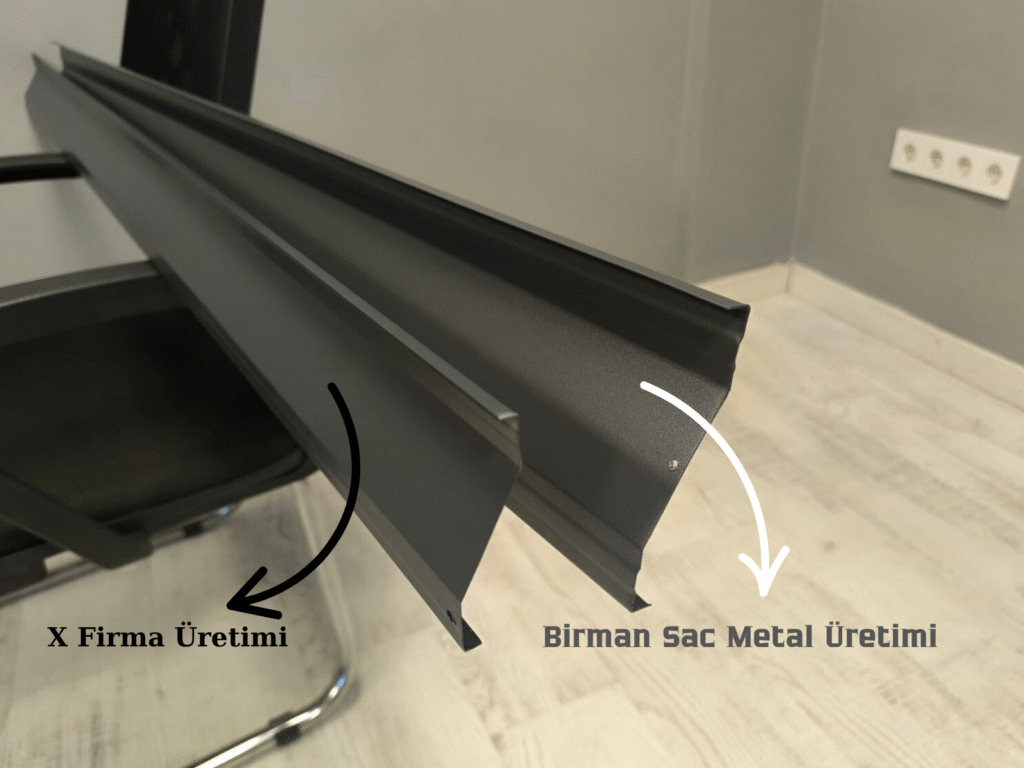
Example of louver sold in 1mm and 1.2mm sizes on the market.
What Level of Strength Should a Metal Slat Fence Provide?
Louver fences generally lose their integrity in a few ways.
- External impacts
Impacts from collisions or intentional blows can damage the louver. They cause bending and, very rarely, tearing. In these cases, usually a part of the fence or a certain number of louvers are damaged. Although these situations are undesirable for users, they are easy to remedy. Since louver fences are demountable, damaged louvers can be replaced with new ones.
- Paint degradation
This is a very common situation. Louver fences are usually painted with electrostatic powder coating. This painting technique is one of the best-known coating techniques. Powder coating is more of a coating process than a painting process. It is carried out by adhering paint pigments of a certain color to the metal material by creating an electromagnetic field, then holding it at 180-200 degrees Celsius for a certain time to liquefy and then harden. Cleanliness is very important in the powder coating process. Paints applied to unclean surfaces detach from the adhered surface in a short time. This is a major problem.
Another major problem in the powder coating process is cheap powder paints. The poor quality of their resins, in particular, causes the painted surfaces to fade quickly. Powder paints used other than well-known quality brands cause problems in outdoor areas.
One of the paint types used in the powder coating process is ‘underscreen’ paint. Underscreen paint refers to paints that have fallen or been collected from the air by suction systems during use, then sieved and reused. It is a very common method in the market. Manufacturers use this method because paint costs are high.
The use of underscreen paints is very dangerous. Dust and similar materials mixed into the paint significantly reduce the color and durability of the paint.
Reducing the baking temperature to shorten curing times also reduces paint quality.
- Wind effect
Wind is the biggest enemy of louver fences. Especially in settlements located by the sea, excessive winds can tear off all or part of the louver fences, or bend the louvers. Therefore, the design of the louvers and posts must be made by calculating the effect of wind in the louver fence design.
The maximum wind load that a structural element (1 meter wide, 10 cm high) can experience in Turkey is calculated according to TS EN 1991-1-4 (Eurocode 1) and the wind maps in the Turkish Building Earthquake Regulation. Here are the basic steps:
1. Basic Wind Speed (vb)
- In Turkey, the maximum basic wind speed is accepted as approximately 40 m/s (144 km/h) (e.g., windy regions like Bodrum, Antalya, Istanbul Strait).
- According to the maps, this value varies by region (e.g., 25-30 m/s in inland regions, 35-40 m/s in coastal areas).
2. Wind Load Calculation (Simplified)
Wind force (Fw) is calculated using the following formula:Fw=12⋅ρ⋅v2⋅Cd⋅AFw=21⋅ρ⋅v2⋅Cd⋅A
- ρ (air density): ~1.25 kg/m³
- v (wind speed): 40 m/s (maximum)
- Cd (drag coefficient): ~1.2 for a flat plate (varies by shape)
- A (surface area): 1 m × 0.1 m = 0.1 m²
Calculation:Fw=0.5⋅1.25⋅(40)2⋅1.2⋅0.1=120 N(≈12.2 kg-f)Fw=0.5⋅1.25⋅(40)2⋅1.2⋅0.1=120 N(≈12.2 kg-f)
3. Detailed Calculation According to TS EN 1991-1-4
- Height and Topography Factor: If the part is low to the ground (e.g., less than 10 m), c<sub>e</sub>(z) ≈ 1.0-2.0.
- Wind Pressure (qp):qp=0.613⋅vb2⋅ce(N/m2)qp=0.613⋅vb2⋅ce(N/m2)For 40 m/s:qp=0.613⋅1600⋅2=1961.6 N/m2(≈200 kg-f/m2)qp=0.613⋅1600⋅2=1961.6 N/m2(≈200 kg-f/m2)
- Net Force: Fw=qp⋅Cd⋅A=1961.6⋅1.2⋅0.1≈235.4 NFw=qp⋅Cd⋅A=1961.6⋅1.2⋅0.1≈235.4 N (≈ 24 kg-f).
4. Additional Factors
- Dynamic Wind Effect: Force can increase by 50% due to sudden wind gusts (turbulence).
- Structural Vibration: Risk of resonance in flexible parts.
Conclusion
- The maximum wind load that a 1 m × 10 cm part can experience in Turkey is approximately in the range of 200-350 N (20-35 kg-f).
- Static and dynamic analysis is recommended for critical structures.
The calculations above were made for a louver 1 meter wide and 10 cm high. Considering the harshest wind load in Turkey at 144 km/h, a louver of the given dimensions is exposed to an effect of approximately 200 to 350 N. This is an approximate pushing or pulling force of 30 kg. Even under these conditions, the louvers should not bend or detach.
By analyzing, we can see the reaction of a louver, made of 0.7 mm thick galvanized hard material, a product of Birman Sac Metal, when exposed to a 300 N impact from the front.
When we examine the analysis, the middle part of the louver deflects by 4.89 mm when subjected to a 300 N impact from the front. Since the louver is made of metal sheet material, this impact does not cause a permanent deformation in the louver material. This shows that a louver with this design will remain sturdy even against the strongest winds.
Similarly, we can analyze how the louver would react to an impact from above.
When we examine the analysis, a force of 450 N is applied to the louver from above. This is equivalent to a person weighing approximately 45 kg sitting on the louver. Under this impact, the louver deflects downwards by 2.17 mm. This impact also does not cause a permanent deformation in the louver.
Based on the results, a 0.7 mm thick product, when correctly designed and made with the right materials, demonstrates the required durability. In a product made with incorrect materials and design, louver thickness alone is not effective.
Factors such as material quality, design, and paint are important for purchasing a quality product.
Specifically, knowing the weight per square meter of the product can provide important clues about the product you are buying.